
 Printer-friendly version

 The colleges offer award-winning programs that celebrate and honor veterans
Photo: Grossmont College student veterans
Source: Grossmont-Cuyamaca Community College District
November 4, 2025 (El Cajon) - Navy veteran Isaiah Nailon had one clear goal in mind when he enrolled at Cuyamaca College in the spring of 2018: taking the first step toward earning a bachelor’s degree.
“That was it,” he said. “Cuyamaca College had one of the best transfer rates to San Diego State University for business administration majors, but everyone in Veterans Services encouraged me, motivated me, and challenged me to dream bigger. ‘Why stop at a bachelor’s degree?’ they said. ‘Why not a master’s?’ It got me to thinking, why not?"
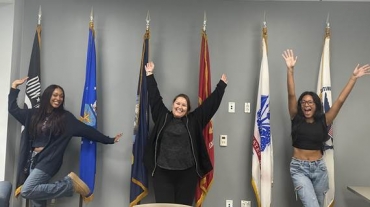 Photo, right: Cuyamaca College student veterans
Why not, indeed. Nailon not only earned his Bachelor of Science Degree in Business Administration, he went on to complete not one, but two master’s degrees – one in business administration and another in education and counseling. Today, he’s back at Cuyamaca College, paying it forward as the Co unseling and Assessment Supervisor and Acting Veterans Center Supervisor and a School Certifying Official.
Nailon’s journey is just one example of the numerous success stories emerging throughout the Grossmont-Cuyamaca Community College District. Similar achievements are also unfolding at Grossmont College, where an impressive Veterans Resource Center has become a focal point for support.
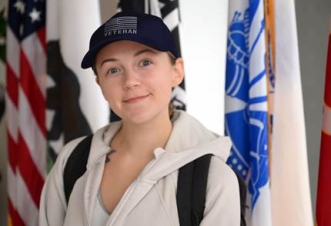 At Grossmont College, Navy veteran Kelly Carlson (left) quickly found the Veterans Resource Center to be an essential part of her daily college experience.
"I’m here every day, mainly for the computer lab; it’s really quiet, really peaceful, and they have all the amenities that you need,” said Carlson, a biology major who spent six years in the Navy as a gunner’s mate aboard the USS Porter before completing her service at Naval Base San Diego.
“The counselors are right across the hall, people are really respectful, and if I ever forget to eat something, I could just go into the kitchen and grab something to eat. They’ve also offered me backpacks, laptops, everything under the sun. It’s truly amazing.”
These welcoming resource centers are made possible because of ongoing community support, including funding from the voter-approved Proposition V. The Grossmont College Veterans Resource Center, for example, features an expansive kitchen and living room, private study area, computer lab equipped with 15 new personal computers and printers, and counseling offices. Upstairs , military-affiliated students can relax in a fully furnished, outdoor lounge offering picturesque views of Cowles Mountain, the highest point in San Diego, and Mission Trails Regional Park. The Center’s stockrooms supply hundreds of laptops and Grossmont College backpacks for veterans and dependents in need.
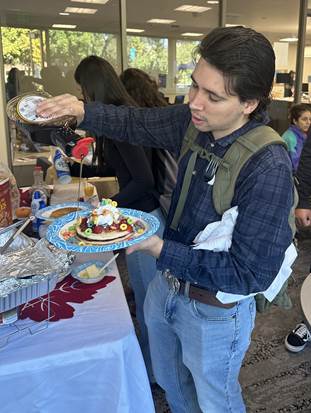 Photo, right: Cuyamaca College 2024 Veterans Day Pancake Breakfast
Veterans Day Celebrations
Both college will be celebrating Veterans Day with activities and events for students and employees on Monday, November 10, 2025. At 9:00 a.m., Cuyamaca College will hold a Pancake Breakfast and a U.S. Marines Birthday Celebration in the Veteran Resource Center (Student Center, I-113). At 12:00 p.m., Grossmont College will host a Salute to Service Luncheon at the Veterans Resource Center (Building 36-100).
Both campuses, through their well-equipped Veterans Resource Centers and dedicated student support staff, illustrate why the Grossmont-Cuyamaca Community College District has become a statewide leader in serving military veterans and their dependents in a region with the highest concentration of military personnel in California.
Across Grossmont and Cuyamaca colleges, military-affiliated students, who include veterans, dependents, and those actively serving, comprise about 2.5% of the 20,538 students enrolled this fall, according to the District’s Office of Research, Planning, and Institutional Effectiveness.
This figure, however, includes only those using VA education benefits and excludes others who qualify but opt to reserve their GI Bill eligibility for future university studies. For instance, Grossmont College estimates approximately 600 military-affiliated students annually, with its Veterans Resource Center logging 1,992 visits during spring 2025. Likewise, Cuyamaca College serves an estimated 400 military-affiliated students each year, with an average of 15 to 20 students visiting its Veterans Resource Center daily.
Award Winning Programs
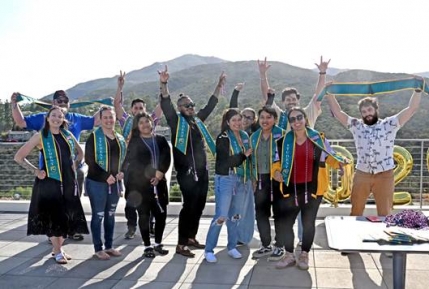 Photo, left: Grossmont College veterans graduation celebration, 2025.
Veterans outreach and support extends beyond campus. The District is an active member of the Veterans East County Alliance (VECA) and the San Diego East County Chamber of Commerce, and was recently nominated for the Alliance’s 2025 VALOR Veteran Friendly Business of the Year for, among other things, its veteran resources and transitioning programs. The District actively participates in local veteran’s oriented events, such as staffing a booth at the Operation Employment Veteran Career and Resource Fair this fall, hosted by VECA and the City of Santee.
In 2024, the East County Economic Development Council recognized the Grossmont-Cuyamaca Community College District with “Partnership of the Decade” honors, in part due to its role supporting and advancing veteran services and workforce training and development.
Both colleges have been recognized by The Military Times as Military Friendly Schools, and for the past three years, The Military Times has recognized Cuyamaca College as a “Best for Vets: Colleges” campus.
Like its counterpart at Grossmont College, the Cuyamaca College Veterans Resource Center provides a welcoming, modern space designed to help veterans succeed, offering access to technology, study areas, and essential supports, including a fully stocked pantry and kitchenette. Veterans benefit from a range of cost-free resources, including gas cards, book vouchers, hands-on assistance with GI Bill benefits, and educational support for dependents. Laptops, books, calculators, and testing materials are available to borrow.
Supporting students on every step of their academic journeys, counselors and dedicated employees at both campuses provide guidance through counseling, career exploration, and the transition from military to college life.
These efforts predate even the California Community Colleges’ Vision 2030 initiative, a system-wide roadmap committed to helping veterans navigate the transition to civilian life and higher education. Groundbreaking efforts like the “Veterans Sprint” ensure every veteran’s Joint Services Transcript is reviewed for college credit. Programs such as the Mental Health for Veterans Demonstration Project expand counseling and mental health support, while the Credit for Prior Learning program acknowledges military experience and training, helping veterans save time and tuition costs on their way to graduation.
Among those thriving in this supportive environment is Marine veteran Damarias Russell. With bachelor’s degrees in psychology and global studies from the University of Arizona and a master’s degree in International Affairs from UC San Diego, Russell recently enrolled at Grossmont College to pursue an Associate of Science in Cybersecurity and Networking.
“It’s a fact that veterans involved with vet centers and who access veterans resources on campus throughout their college experience do better academically than those who don’t,” said Russell, 37, who served as a Marine security guard in Athens, Baghdad, and Accra, Ghana. “I know I would not have been as successful academically had it not been for Vet Centers like this.”
New Leadership at the Grossmont and Cuyamaca College Veterans Centers
Grossmont College
Gregory Pace has dedicated most of his life to serving others. A medically separated U.S. Marine Corps Captain and graduate of the U.S. Naval Academy with a bachelor’s degree in physics, Pace later built a successful private-sector career that included roles as a financial center manager at JPMorgan Chase and vice president of operations at Huffy Corporation. He also served as a campus president and National Director of Military and Veterans Affairs at DeVry University.
Today, Pace brings his extensive experience in both public and private service to his new role as supervisor of the Grossmont College Veterans Resource Center. He assumed the post as the fall semester began at East County’s largest hub for higher education and workforce training.
“My aim is to build upon our strong military and veteran community and help our students achieve their educational and career goals,” Pace said. “My vision is to deliver consistently high-quality service, expand student engagement, foster camaraderie and care, and continuously improve the resources we offer to support our students.”
Why Grossmont?
“I believe deeply in the power of education to transform lives, and my career has always centered on service to others. I’m fortunate to have had leadership opportunities that allow me to help people succeed – it’s one of my passions. The mission and values of Grossmont College align closely with my own, and this role allows me to serve both a community I identify with and the one I call home.”
Cuyamaca College
Originally from the Sacramento suburb of Lincoln, Davis joined the Navy after graduating from high school and was assigned to the amphibious assault ship USS Boxer, stationed in San Diego. After leaving the Navy in 2008, he enrolled at Grossmont College, served as president of the Veterans Student Organization, and successfully lobbied administrators to authorize the campus’s first Veterans Resource Center in 2009.
Davis later earned a bachelor’s degree in anthropology from San Diego State University and a master’s degree in educational leadership from Mills College. His résumé includes positions as a military certifying official at Mills College, a military certifying official and alumni association coordinator at San José State University, and program manager for the Office of Military Affiliated Communities at Stanford University.
Now he’s back home in El Cajon.
“I feel like I’ve come full circle,” Davis said from his new office at the spacious Veterans Center at Cuyamaca College, where he began his new role on October 20. “I don’t recall ever being in a Veterans Center this big before—or one with such a large outdoor space. It’s amazing.”
Davis plans to collaborate with the college community and local nonprofits, including the Rotary Club, to create or expand career readiness, mentorship, and orientation programs for veterans. “We’re here for our students, and we have to give them what they want,” he said. “Community colleges are the best vehicle for military veterans transitioning to civilian life.”
As the largest institution of higher education in East County, the Grossmont-Cuyamaca Community College District, has enhanced the quality of life in East County for over 65 years by providing top notch, affordable education and workforce training. The 1,138-square-mile District includes communities such as El Cajon, Santee, Lemon Grove, Spring Valley, San Diego, and the unincorporated County. Our institutions offer a variety of convenient online and in-person classes, along with competitive degree and certificate programs. The District, which includes Grossmont College and Cuyamaca College, serves over 29,000 students annually, and awards over 6,000 degrees and certificates each year. The colleges are consistently ranked as top transfer institutions to SDSU. Grossmont College first convened classes in 1961 and serves over 19,000 students every year. Cuyamaca College was built in 1978, and enrolls nearly 10,000 students yearly. The colleges lead the way in developing educational programs, classes, and services that meet the diverse needs of East County's student population.






Recent comments