
 Printer-friendly version

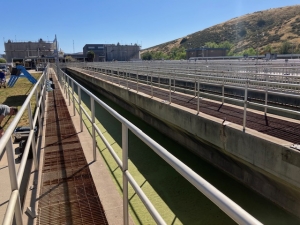 Ray Stoyer Water Recycling Facility at Padre Dam Municipal Water District, Santee Lakes
Community event makes way for the East County Advanced Water Purification Program
Story and photos by Paul Levikow
April 13, 2026 (Santee) -- After more than a half-century of water reuse in East County, the Ray Stoyer Water Recycling Facility has been decommissioned, marking the end of an era and the beginning of a new chapter in regional water sustainability.
Padre Dam Municipal Water District officials marked the milestone April 8 by ceremonially pulling the railing at the facility’s aeration basin adjacent to Santee Lakes, closing the book on a plant that was ahead of its time that helped shape modern recycled water practices.
The Ray Stoyer Facility was relocated to its current site in 1968 and became a workhorse in a region often challenged by drought and limited imported water supplies. A 1997 expansion increased its capacity to produce up to two million gallons of recycled water daily, supporting Santee Lakes and a range of non-potable uses across the community.
It was named after former Santee County Water District General Manager Ray Stoyer and the facility stood as an example of early innovation in water reuse long before conservation became a household word. Its legacy reflects the simple idea that water is too valuable to use just once.
“The Ray Stoyer Water Recycling Facility has been a cornerstone of water sustainability in East County for more than half a century,” Padre Dam General Manager and CEO Kyle Swanson said. “Its legacy of innovation has set the standard for responsible water reuse.”
That legacy will now carry forward through the East County Advanced Water Purification (AWP) Program, a major investment aimed at creating a drought-proof, locally controlled drinking water supply.
The new system will use advanced purification technology to treat up to 16 million gallons of wastewater daily, producing about 11.5 million gallons of potable water, enough to meet about 30 percent of the region’s demand.It will be coming online in stages, producing purified water beginning at the end of this year.
East County Advanced Water Purification Program nearing completion at Santee Lakes to replace Ray Stoyer Water Recycling Facility (right)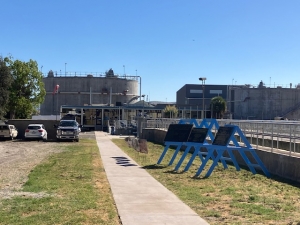
The full commercial operation is scheduled to be up and running in 2027, according to Swanson. In the meantime, recycled water will be coming from the new facility. As a result, the water in Santee Lakes will become cleaner and fishing and boating will still be allowed.
“This program will provide a clean, safe, high-quality drinking water source while strengthening long-term reliability for the region, including during periods of drought,” Swanson said.
For longtime employees, the transition is both professional and personal. Rob Northcote, operations manager for the East County AWP Program, began his career at the Ray Stoyer facility in 1997. He described it as more than just a workplace.
“It’s been distinguished by its history, innovation, and depth of expertise,” Northcote said. “The dedication of the people who worked here will help guide the next generation of water purification.”
The new AWP facilities, visible from the decommissioned plant, symbolize that transition, linking decades of recycled water innovation to a future defined by advanced treatment and increased water independence.
“The East County AWP Program reflects years of planning, coordination and commitment from multiple agencies as well as continued support from this community,” Padre Dam Board President Bill Pommering said. “The facility being developed here will significantly expand the work that began with the Ray Stoyer water recycling facility, in providing a high-quality, locally controlled drinking water source for residences and businesses for decades to come.”
Mark Niemiec is the project director leading the team toward completion of the AWP Program.“
We had a vision and we are seeing that vision become a reality,” Niemiec said, calling it a “generational project that is helping us address near and long-term water supply challenges in the San Diego area.”
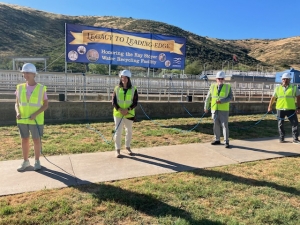 Padre Dam Municipal Water District Board of Directors pull down railing at Ray Stoyer Water Recycling Facility decommissioning (left)
Niemiec told a crowd of elected officials, dignitaries, community members, employees, partners, and stakeholders that Padre Dam and the AWP facility is at a new level of innovation, clearly placing it on the leading edge of water reuse in California.
“We are at the final stages of construction for the AWP Project,” he said. “Buildings are up, final electrical and wiring work is being completed, setting the stage for bringing wastewater to the new facilities this summer for start of the testing activities.”
In addition, construction of the laboratory completion is being expedited, which will allow lab staff to work toward obtaining the necessary certification and operate the new state-of-the-art facility.






Comments
Actually...
I'm still concerned...
That's an understandable concern. That said,
the water we've been drinking from sources such as the Colorado River are far from clean before filtration. Even such "natural" sources can contain urine or fecal material from animals or human hikers, chemicals from agircultural runoff and other contaminants.I'm told the AWP facility will purify water to cleaner standards than what we are already drinking, assuming it all works according to plans.
We have a reverse osmosis filter on our kitchen sink, which helps filter out some items of concern on top of whatever filtration the water district we're in provides. These are inexpensive and while it doesn't work for everything, it does provide an added layer of filtration.
you must not know about orange county calif